In today’s AI-driven search landscape, FAQ sections have evolved from simple UX features into powerful SEO and AI optimisation tools. Whether you’re targeting Google’s AI Overviews, voice search results, or citations in generative platforms like ChatGPT or Perplexity, well-structured FAQs can dramatically enhance your site’s visibility and authority.
At Digital Hothouse, FAQs have long been a key part of our SEO strategies for clients, however, with the rapid expansion of AI search, this tactic has come to the forefront of some of the work we are doing for our clients, looking at further ways to expand on existing FAQ content and seeing where FAQs fit in with landing page copy, blog posts and other key pages on our clients’ sites.
This guide explores how to structure, write, and optimise FAQ content for both traditional SEO and AI search, helping your brand stay discoverable, trusted, and cited in 2025 and beyond.
Why AI-Optimised FAQs Are Critical for Search Visibility
FAQs are a direct bridge between user intent and structured information delivery. When designed strategically, they improve user experience and make your content easier for AI systems to interpret.
Key reasons FAQ optimisation matters:
- FAQs align with how people naturally ask questions – a crucial factor for AI-driven discovery and voice search.
- Structured FAQ markup helps Google and AI search tools extract precise, authoritative answers.
- Regularly updated FAQ content signals freshness, relevance, and expertise to search engines.
- Well-built FAQ pages enhance entity recognition and improve your brand’s presence in knowledge graphs and AI-generated summaries.
By researching and writing FAQs that reflect genuine user language and intent, you can position your brand as a go-to authority in your industry.
How to Structure FAQ Content for AI Search
Getting your FAQ structure right is fundamental to both user engagement and SEO performance.
Best practices for structuring FAQs:
- Group by theme or intent: Organise questions based on customer journeys – pre-purchase, onboarding, troubleshooting, or comparison.
- Use real user data: Source questions from customer service chats, “People Also Ask” results, and sales interactions.
- Choose the right layout:
- Small sites: one central FAQ page.
- Larger sites: multiple topic-based FAQ modules (e.g. product-specific or service-specific pages).
- Position strategically: Display FAQ sections near the top or clearly signposted on product, service, or support pages. We often use anchor links at the top of a product or category page, which allows visitors to quickly navigate to the FAQ content, even if it is positioned at the bottom of the page.
- Ensure mobile-first design: Use expandable sections and avoid animations that block content visibility or slow page load.
A logical, mobile-friendly FAQ structure supports easy navigation for readers while allowing crawlers and AI systems to process Q&A pairs efficiently.
Writing FAQs in Natural Language for SEO and AI
AI assistants and search engines increasingly rely on natural-language understanding (NLU). That means your FAQ copy should sound like your users, not your internal team.
Tips for writing AI-friendly FAQs:
- Use conversational phrasing and question formats people actually type or say aloud.
- Keep answers concise (40–60 words) and focus on one clear intent per answer.
- Reuse phrases from real customer language to improve semantic matching with AI models.
- Avoid jargon – use everyday terms that reinforce clarity and relevance.
For example, instead of:
“What optimisation processes are used to enhance FAQ discoverability?”
Say:
“How do I make my FAQs show up in Google or AI search results?”
This tone helps your answers perform well in both voice assistants and AI-generated summaries.
How to Implement FAQ Schema for AI and Knowledge Graphs
Adding structured data is one of the fastest ways to make your FAQs machine-readable and eligible for enhanced visibility.
Best practices for schema optimisation:
- Use FAQPage schema to mark up each Q&A pair.
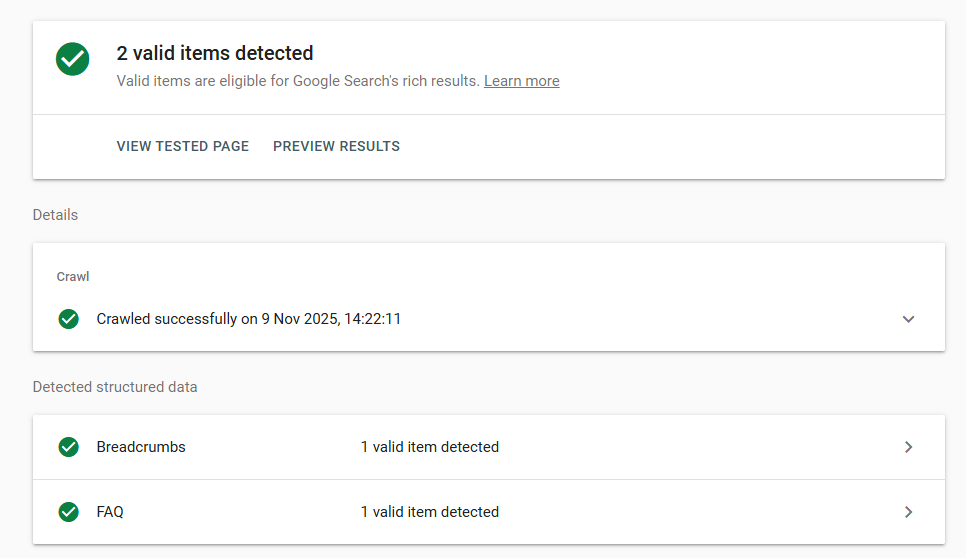
- Validate your schema using Google’s Rich Results Test or Schema.org tools.
- Ensure each question and answer pair is unique, complete, and well-formatted.
- Link internally where helpful (e.g. from FAQs to detailed guides or service pages) to strengthen entity connections and topical authority.
Example snippet:
{
“@context”: “https://schema.org”,
“@type”: “FAQPage”,
“mainEntity”: [{
“@type”: “Question”,
“name”: “How does FAQ schema help SEO?”,
“acceptedAnswer”: {
“@type”: “Answer”,
“text”: “FAQ schema helps search engines and AI systems understand your Q&A content, increasing the likelihood of being featured in AI Overviews, voice search, and rich results.”
}
}]
}
Implementing FAQ schema isn’t just good SEO; it’s foundational AI readiness.
Top tip: writing FAQ schema used to be time-consuming; however, this is where tools like ChatGPT and Perplexity can significantly reduce time-consuming tasks. Simply ask your preferred tool to generate JSON-LD FAQ schema for your chosen FAQ content, and it will produce the file with script tags for you.
Building Trust: Citations and Authoritative FAQ Answers
AI engines prefer factual, sourced content from trusted domains. Every FAQ is an opportunity to demonstrate authority.
Best practices:
- Support claims with reputable sources, such as Google documentation or industry research.
- Link internally to case studies or data-driven insights to reinforce authority.
- Write summary-style answers that lend themselves to direct inclusion in AI-generated responses.
- Keep tone professional, confident, and evidence-based – qualities that improve AI citation likelihood.
By weaving in verifiable facts and trustworthy references, your FAQ content can earn recognition as a credible citation source.

Technical SEO for FAQ Content
Technical excellence ensures your FAQ sections are crawlable, indexable, and accessible for both humans and AI.
Technical checklist:
- Use clear H2/H3 tags for question headings.
- Optimise page load speed – AI engines deprioritise slow or script-heavy pages.
- Link FAQs internally to relevant pages (e.g. product categories, service details, or blog posts).
- Ensure content is indexable and not blocked by JavaScript or modal windows.
- Monitor with Google Search Console to track visibility in AI Overviews and rich results.
Good technical hygiene lets your FAQ content shine across evolving search environments.
Staying Ahead: Advanced FAQ SEO Strategies for 2025 and Beyond
The biggest FAQ SEO advantage in 2025 and beyond comes from consistency and adaptability.
To stay ahead:
- Treat FAQs as living content – update regularly with new customer queries and trends.
- Conduct quarterly audits to add or retire questions based on analytics and search demand.
- Localise for your markets (NZ and UK) using country-specific spelling, terminology, and references.
- Incorporate emerging AI search trends, such as multimodal queries or context-aware follow-ups.
- Include calls to action (e.g. “Need help?” or “Explore our SEO services”) where appropriate.
Ongoing optimisation ensures your FAQs remain relevant, visible, and competitive.
Internal Linking Best Practices for FAQ SEO
Smart internal linking strengthens topic clusters and helps AI systems understand content relationships.
Practical examples:
- For a complete strategy overview, see What to Include in Your SEO Strategy.
- Learn about the difference between GEO, SEO and Local SEO.
- Explore What Is AI Optimisation and Why It Matters for Your Business.
- Read Evolving Search Intent: A Glimpse into Shifting Sands for insights on user intent.
- See more examples in 5 Types of Highly Effective Blog Posts You Should Be Publishing Today.
- Review How to Clean Up Your SEO: 7 Steps to Improve Your SEO.
These internal pathways help both users and AI crawlers deepen their understanding of your expertise. Tagging them onto a relevant answer in the FAQs as a call-to-action allows you to link out to relevant content on your site and encourages your visitor deeper into the site to learn more.
Frequently Asked Questions
How does FAQ schema help SEO and AI results?
FAQ schema structures content so search engines and AI assistants can extract question-answer pairs directly, improving the likelihood of appearing in AI Overviews, voice search, and featured snippets.
What kind of language should FAQs use for AI?
Use conversational, natural language that mirrors real user queries. This supports both semantic search and natural-language processing used by AI systems.
How often should FAQ sections be updated?
Review at least quarterly, but update anytime new questions arise or products evolve. Freshness signals help maintain strong ranking and AI relevance.
Is one FAQ page or multiple better for SEO?
Small sites benefit from a single, centralised FAQ page, while larger brands should use multiple topical FAQs to target specific intent clusters.
Can FAQs appear in AI or voice results?
Yes. Well-structured, schema-marked FAQs are often surfaced in AI summaries, voice search, and chat-based responses when written in clear, factual language.
Conclusion: Turning FAQs Into an AI Search Advantage
FAQs are no longer an afterthought – they’re a core SEO and AI content asset. When built with structure, schema, and semantic clarity, they enhance both organic rankings and AI search visibility.
At Digital Hothouse, we help NZ and UK businesses future-proof their SEO strategies by optimising content for the era of AI-first discovery. For tailored support, future-proof analytics, and hands-on guidance on the next evolution of search, talk to Digital Hothouse today.
About This Series
This article is part of our ongoing series on AI Optimisation – helping business leaders, marketers, and SEO professionals in New Zealand and the UK understand how AI is reshaping search. If you want to dive deeper, check out our whitepaper The Future of Search: Beyond Rankings and Traffic and explore our dedicated AI Optimisation services page. Together, these resources will help you future-proof your visibility in a world where AI search engines deliver answers, not just links.
Download Our Whitepaper
Want a deeper dive into how AI is reshaping search?
Download our whitepaper: The Future of Search: Beyond Rankings and Traffic for practical insights, case studies, and actionable steps your business can take today.