The Google SERP is no longer a ranked list of ten blue links. Web Guides, AI Overviews, featured snippets, knowledge panels, and AI Mode now compete for the same screen space, each rewarding different content formats and optimisation approaches. For technical SEO professionals and search strategists in New Zealand and the UK, winning in today’s search features requires understanding how each surface selects content, what format signals it prioritises, and how to structure pages so that a single piece of content can qualify for multiple placements at once.
This post breaks down each major feature, explains the optimisation strategy for each, and provides practical diagnostic steps you can act on today.
Introduction
Google’s search results page (SERP) has never been more crowded or more consequential. A query that once returned a clean list of ranked links now triggers a layered mix of AI-generated summaries, thematically grouped web results, answer boxes, people also ask panels, and local listings. Each of these features captures attention and clicks that previously flowed to organic positions 1 through 10.
For technical SEO professionals and search strategists, this is both a challenge and an opportunity. The challenge is that traditional rank tracking no longer tells the full story of your visibility. The opportunity is that the SERP now has more entry points than ever before, and a well-structured page can claim several of them simultaneously.
At Digital Hothouse, we work with businesses across New Zealand and the UK to build SEO strategies designed for this multi-feature reality. Here’s a structured guide to the key search features, how they work, and how to win them.
What Is Google Web Guide?
Launched as a Search Labs experiment in July 2025, Google Web Guide is one of the most significant changes to the organic search experience in years. Rather than displaying a flat list of ranked links, Web Guide uses a custom version of Gemini to group search results into thematic clusters, each addressing a different aspect of the user’s query.
The mechanism behind it is a technique called “query fan-out”. The AI breaks a single search query into multiple related sub-queries, explores them concurrently, and organises the most relevant pages into labelled sections. A search for “how to solo travel in Japan” might yield sections like “Comprehensive Guides,” “Safety Tips,” “Personal Experiences,” and “Budget Planning” – each surfacing different pages that would otherwise compete for a single organic position.
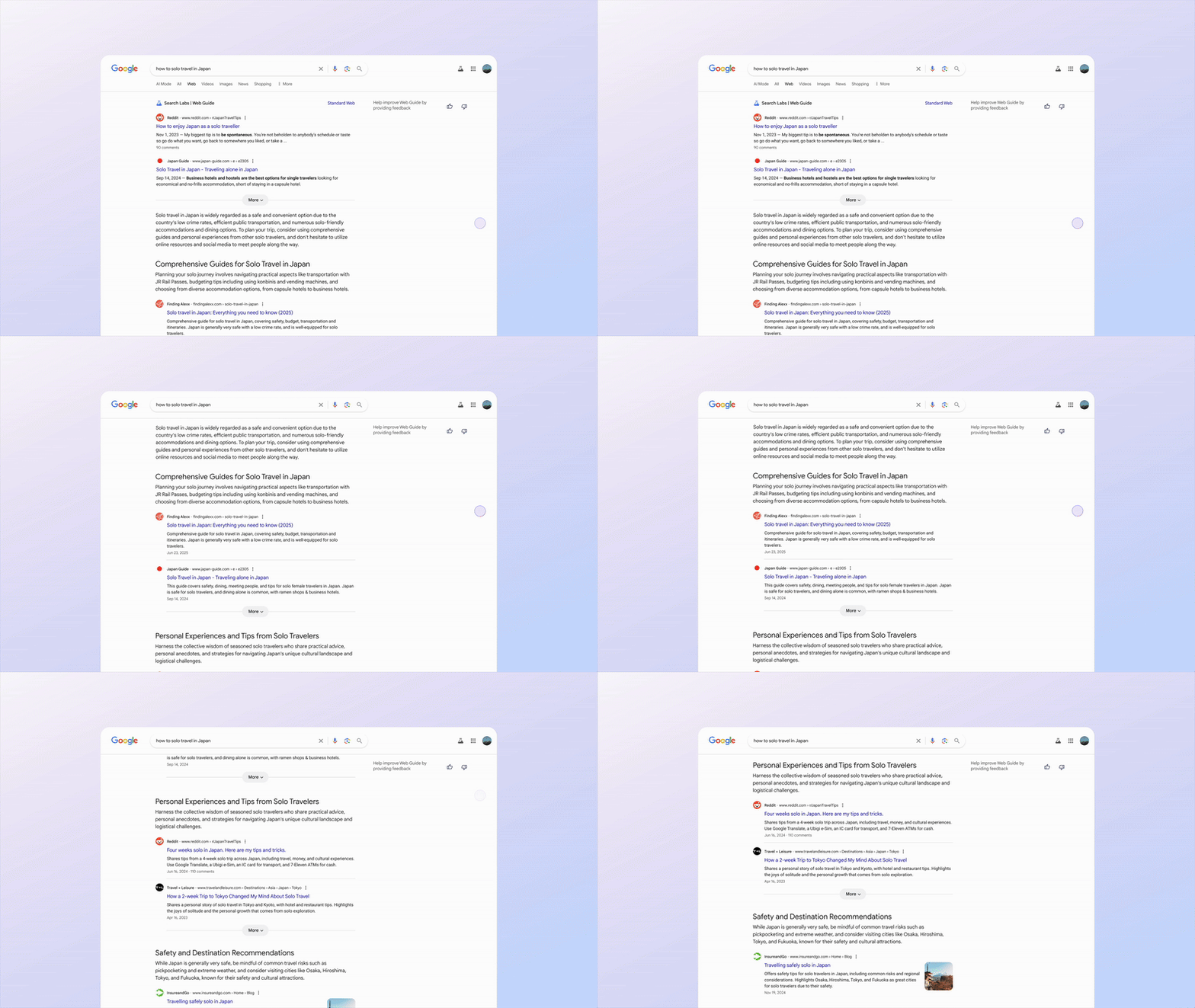
Critically, Web Guide is the most publisher-friendly of Google’s AI features to date. Unlike AI Overviews or AI Mode, which can satisfy a query without a click, Web Guide surfaces clickable web pages exclusively. Research from Ahrefs indicates that AI Overviews suppress clicks by approximately 58%, while Web Guide, by design, still requires users to click through to access the full content. For publishers and content-heavy brands, this is a meaningful distinction.
As of early 2026, Web Guide remains opt-in via Google Search Labs and is particularly active for exploratory, open-ended, and multi-intent queries. It doesn’t currently replace the default “All” tab for all users, but its expansion to the main tab has been tested, and Google’s own blog post confirms it is built on the same core systems as traditional search, meaning existing ranking signals still apply, but topical cluster architecture becomes an additional competitive lever.
Google AI Overviews Explained
Google AI Overviews are AI-generated summaries that appear at the top of the SERP in response to informational and complex queries. Powered by Gemini, they synthesise content from multiple web sources into a concise, structured answer with cited source links below.
According to Search Engine Land’s guide to Google AI Overviews, AI Overviews now appear in over 50% of all search results when accounting for all device types and query types; a coverage rate that has expanded dramatically since the March 2025 core update, which triggered a 528% increase in AI Overview appearance for entertainment queries and a 387% increase for restaurant queries in a single two-week period.
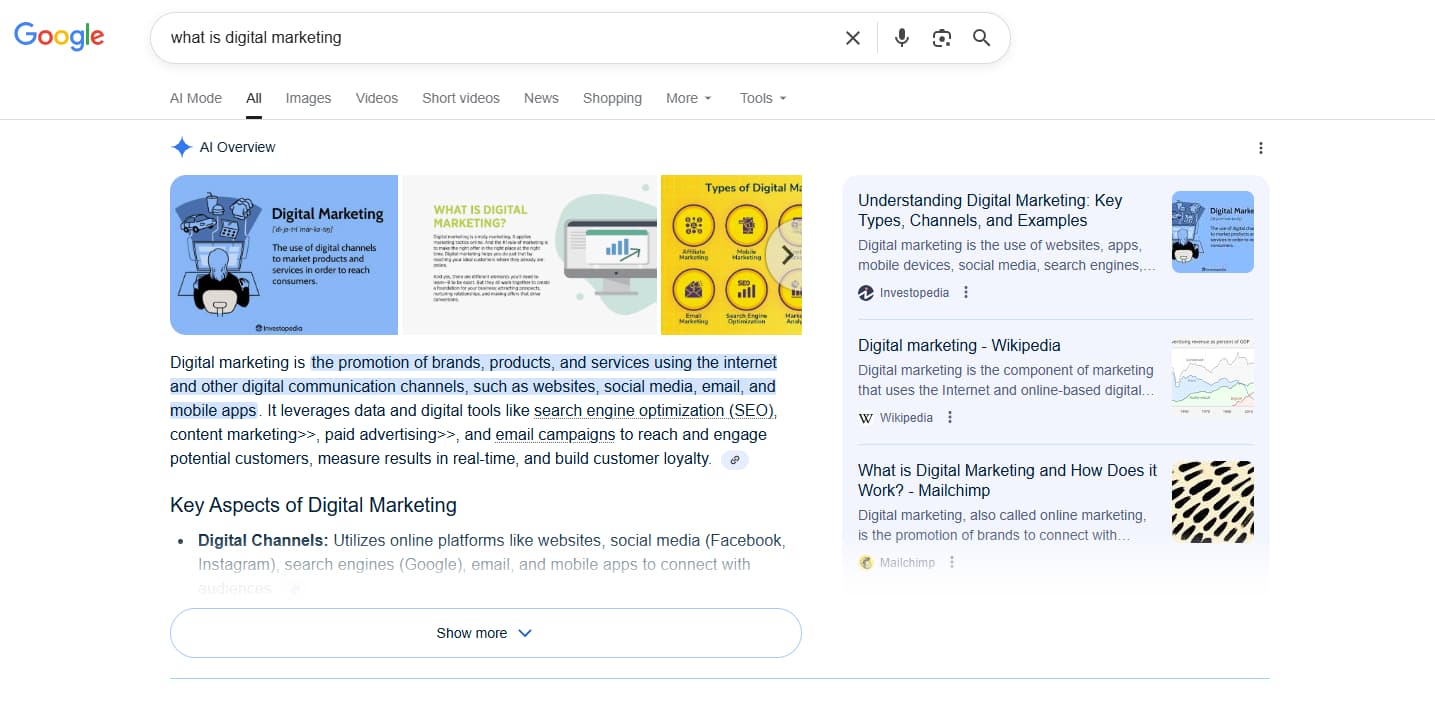
The traffic impact of AI Overviews is significant. Organic CTRs for positions 1 through 5 have declined by an average of 17.92% on queries where AI Overviews appear. However, Google’s own developer guidance confirms that clicks arriving through AI Overview citations tend to be higher quality, with users more likely to spend extended time on the destination site. The implication is that citation in an AI Overview may be more valuable per visit than a traditional organic click, even if total click volume is lower.
The Digital Marketing Institute’s analysis of AI Overviews reinforces this: brands that are cited within AI Overviews earn 35% more organic clicks and 91% more paid clicks than competitors that are not cited. For brands also running Google Ads campaigns alongside organic activity, this interaction effect represents a compounding advantage worth factoring into integrated search strategy.
Optimisation Strategies for Each Feature Type
Web Guide Optimisation
Web Guide rewards topical cluster architecture rather than individual page optimisation. The following principles apply:
- Build content clusters, not isolated pages. Web Guide’s query fan-out means Google is generating sub-queries from your head term. If your site answers multiple angles of a topic across interconnected pages, you are more likely to appear in multiple clusters within a single Web Guide result.
- Label your content type clearly. Web Guide clusters pages by type: guides, personal experiences, forum discussions, official resources. Your content should signal its type through heading language, schema markup, and URL structure.
- Prioritise click-worthy titles. Because Web Guide surfaces clickable links, the title tag and meta description need to compete for user attention at the cluster level, not just the SERP level.
- Invest in niche depth. Smaller and mid-sized publishers can surface within Web Guide clusters even without dominating head terms, provided their content addresses a specific angle with genuine clarity and depth.
AI Overview Optimisation
Winning an AI Overview citation is not about ranking first. Forty-seven per cent of AI Overview citations come from pages outside the top five organic positions. The selection criteria are content-level, not position-level:
- Write self-contained answer passages. Place a complete, concise answer to the primary query within the first 200 words of the page. AI systems prioritise passages that can be extracted without surrounding context.
- Add verifiable citations throughout. Content with cross-referenced, authoritative sources shows 89% higher AI selection rates. Link to government data, academic sources, and established industry publications.
- Use structured heading hierarchy. H1 through H3 headings should map directly to the questions a user could ask about your topic. This signals clear topical coverage and supports passage-level extraction.
- Implement author attribution and schema. 96% of the AI Overview content comes from verified, authoritative sources. Article schema with named author, datePublished, and publisher fields reinforces trust signals.
- Maintain page freshness. AI Overview selection correlates with content recency, particularly for fast-moving topics. A regular review and update cycle for priority pages is essential.
Featured Snippets
Despite the rise of AI features, featured snippets remain a high-value SERP placement for transactional and definitional queries. They appear above the organic results and answer a query directly from a single source page; a distinct advantage from AI Overviews, which synthesise across sources.
Featured snippet optimisation is precise: identify queries where a snippet is already present, target the content format the snippet uses (paragraph, list, or table), and provide a cleaner, more direct version of the existing answer. The target passage length for paragraph snippets is 40 to 60 words.
Knowledge Panels and Answer Boxes
The Google knowledge panel and answer box are entity-driven surfaces that surface structured data from Google’s Knowledge Graph. For brands and public figures, claiming and verifying your knowledge panel through Google Search Console establishes a direct entity relationship. For organisations, ensuring consistent NAP (name, address, phone) data across your website, Google Business Profile, and third-party directories ensures accurate knowledge panel population.
Competitive Analysis in Feature-Rich SERPs
In a SERP where AI Overviews and Web Guide clusters occupy the top of the page, traditional competitive analysis based on rank position is no longer sufficient. A competitor sitting at position 8 could be cited in the AI Overview, while your position 2 result is being bypassed entirely.
Effective SERP competition analysis for 2026 and beyond requires tracking:
- AI Overview citation frequency for your target queries (which sites are being cited and how often)
- Feature presence by query: which of your target terms are triggering AI Overviews, featured snippets, Web Guide, People Also Ask, or local results
- Competitor content architecture: whether competing pages are using structured data, clear answer passages, and topical cluster linking
- Share of voice across SERP features, not just organic rank position
Tools including Semrush’s AI Visibility Toolkit, SE Ranking’s AI Results Tracker, and Google Search Console’s Insights report, provide the feature-level visibility data that traditional rank trackers do not capture. For analytics teams building SERP monitoring dashboards, these data sources should sit alongside organic impressions and click data.
Hypothetical Case Study: Winning Web Guide Placement in a Competitive Category
Client Scenario: NZ Financial Services Brand
A New Zealand financial services client was experiencing declining organic CTR on their top informational queries, despite holding positions 2 and 3 for several high-volume terms. Analysis revealed that AI Overviews were appearing on 68% of those queries, and Web Guide was clustering their content away from the first visible section.
An intervention for this type of client would focus on three areas: restructuring their top ten blog pages with explicit answer passages in the first 150 words; adding FAQPage and Article schema with full author attribution; and building a topical cluster linking five previously siloed pages into a structured content hub.
By carrying out this work, we would expect the client to appear in AI Overview citations for a number of their target queries as well as securing Web Guide placements for the newly created cluster sections for their primary head term. This would then have a positive knock-on effect on Organic CTR for cited pages, showing increases consistent with the higher-intent audience that AI-referred traffic represents. For integrated campaigns, Google Ads performance on branded terms would also benefit as AI Overview visibility increased brand recognition at the top of the funnel.
Featured Snippets vs AI Overviews: When to Target Which
This is a practical decision that depends on query type, commercial intent, and the competitive SERP landscape:
- Target featured snippets for: “what is” and definitional queries, step-by-step how-to content, comparison tables, and queries where a single authoritative source is expected. Featured snippets are also preferable where the query has lower AI Overview coverage, as snippet placement retains higher CTR when AI features are absent.
- Target AI Overview citation for: multi-source informational queries, complex research topics, “best” and “guide to” queries, and any category where users are likely to want synthesised rather than single-source answers. AI Overview citation requires entity authority and content completeness, not just keyword relevance.
- Target both simultaneously for: high-value commercial categories where the AI Overview appears but a featured snippet also exists below it. Pages optimised for passage extractability often qualify for both, and co-appearing on the same SERP page in two features compounds visibility significantly.
One important distinction that most SERP guides overlook: featured snippets and AI Overviews are not mutually exclusive, and they are not in direct competition for the same content. A page that holds the featured snippet position can simultaneously be cited within the AI Overview from a different passage. Building content that satisfies both simultaneously is the strategic goal for high-value queries.
Content Requirements and Formats for Each Search Surface
The table below summarises the core content and technical requirements for each major SERP feature. For technical SEO professionals implementing these at scale, each requirement maps to an auditable, actionable technical or editorial action.
| SERP Feature | Content Format | Technical Requirements |
| AI Overview | Self-contained answer passages (150-200 words); entity-rich content; multi-source topic coverage; authoritative citations | Article/BlogPosting schema; named author; FAQPage schema; clean crawlability; mobile performance |
| Web Guide | Topical cluster pages; content type clearly signalled (guide, experience, resource); strong internal linking across subtopics | Descriptive H1/H2 hierarchy; updated XML sitemap; logical URL structure; fast TTFB |
| Featured Snippet | Direct answer in first 40-60 words; list or table format where applicable; single-source answer quality | Proper heading tags; no blockquotes wrapping answer text; canonical URL confirmed |
| Knowledge Panel | Consistent entity data across site, GBP, and third-party directories; Wikipedia/Wikidata presence for brands | Organization schema; sameAs properties; verified GBP listing; structured NAP data |
| People Also Ask | Concise question-and-answer pairs; FAQ format; question phrasing matching conversational intent | FAQPage schema; H3 question headings; answer passages under 100 words per question |
Market-Specific Considerations: New Zealand and the UK
AI Overview coverage and Web Guide availability vary by geography, and both markets present distinct strategic considerations.
In the UK, AI Overview rollout has closely mirrored the US, with similar patterns in query type distribution and feature frequency. SE Ranking’s 2024 AI Overview research confirmed that the UK market shows particular weighting toward authoritative local sources such as gov.uk; a signal that businesses in regulated sectors (finance, legal, health) should prioritise government and professional body citations as part of their AI Overview optimisation strategy.
In New Zealand, AI Overview deployment is active across major English-language query types, though the smaller pool of high-authority local sources means that mid-tier New Zealand publishers face less competition for AI citations than their UK counterparts. For NZ brands, this represents a genuine opportunity: a well-structured, authoritative local content piece can earn AI Overview citation ahead of larger international publishers, provided it signals clear regional relevance.
For our AI Optimisation clients across both markets, we apply region-specific entity tagging, LocalBusiness schema with market-correct identifiers, and geo-targeted structured data to ensure AI systems correctly attribute and prioritise content by geography.
Related Reading from the Digital Hothouse Blog
- In-Context Ranking (ICR): The Next Frontier in AI Search Algorithms
- Structured Data for AI Search: A Practical Implementation Guide
- Understanding AI Overviews: What the Data Tells Us About Content Selection
- E-E-A-T in the Age of Generative AI: What Authority Really Means Now
Frequently Asked Questions
What is Google Web Guide and is it live yet?
Google Web Guide is an AI-powered search feature that organises results into themed clusters rather than a flat ranked list. Launched as a Search Labs experiment in July 2025, it remains opt-in as of early 2026, available through Search Labs for users who activate it. It has been tested in both the “Web” tab and the main “All” tab. Web Guide uses a custom version of Gemini and a query fan-out technique to break search queries into sub-queries and group relevant pages by topic.
How do I get my content into Google AI Overviews?
There is no direct submission process for AI Overviews. Selection is based on content quality, entity authority, and passage extractability. The highest-impact steps are: write a concise, self-contained answer near the top of the page; implement Article or BlogPosting schema with named author attribution; add verifiable citations to authoritative external sources; and ensure your pages are fully crawlable with no conflicting indexing directives. According to Google’s own guidance on succeeding in AI search, the core principle is to focus on original, helpful content that satisfies the user’s need completely.
Do featured snippets still matter with AI Overviews on the SERP?
Yes. Featured snippets remain valuable, particularly for queries where AI Overviews are not present and for definitional or step-by-step query types. More importantly, a page can hold the featured snippet and be cited within the AI Overview simultaneously, from different passages. Optimising content for passage extractability, which is the core requirement for both features, means a single content piece can qualify for both placements at once.
What is the difference between AI Overviews and AI Mode?
AI Overviews appear as a summary at the top of standard Google search results, synthesising content from multiple pages to answer a query. AI Mode is a separate, conversational interface that operates more like an AI chatbot; it allows follow-up questions, processes more complex multi-step queries, and uses a deeper version of Gemini’s reasoning capability. AI Mode was launched in the US in Q1 2025. Web Guide is a third, distinct feature that organises existing web links into themed clusters without replacing them with a generated answer.
How should analytics teams measure performance across these SERP features?
Traditional rank position and organic CTR remain useful baselines but must be supplemented with feature-level visibility data. Analytics teams should track: AI Overview citation frequency (using manual SERP checks or tools like Semrush’s AI Visibility Toolkit), featured snippet ownership for target queries, impression and CTR data segmented by query type in Google Search Console, and conversion rates from AI-referred sessions (which typically show higher engagement than standard organic sessions). Brand mention tracking across third-party sources also becomes a leading indicator of AI citation likelihood.
Does Web Guide optimisation require a different approach to keyword research?
Yes, in an important way. Web Guide’s query fan-out means Google generates sub-queries from your head term automatically. Keyword research for Web Guide optimisation should therefore include not just the primary target term, but the full cluster of related sub-intents a user searching that term might also need. This expands the scope of content strategy from individual page optimisation toward topic cluster architecture: a hub page addressing the head term, supported by satellite pages covering specific angles, each internally linked to the hub.
How does Google Web Guide affect Google Ads performance?
Web Guide, unlike AI Overviews, still surfaces clickable links, which preserves the traditional click-to-site flow that Google Ads campaigns rely on. However, the query fan-out mechanism changes which intent signals are most prevalent at the moment of click; meaning paid search targeting may need to account for a broader range of sub-intent queries alongside head terms. For brands running integrated search campaigns, our Google Ads team analyses SERP feature presence as part of the keyword strategy process, ensuring paid and organic efforts are complementary rather than competing for the same high-intent moments.